You know the sound.
The soft ping of a survey reminder. The cheerful chime of a town hall beginning. The applause when a leader announces that employee satisfaction is up again: way up: despite the fact that half the room looks like it has just survived a soul-crushing barrage of meetings, layoffs, and “quick asks.”
Then the slide appears:
92% employee satisfaction.
The room claps.
Someone unmutes.
Someone else whispers, “Are we talking about the same company?”
Welcome to metrics theater: the latest production in the ongoing performance theater of corporate culture.
The ColdPlayed Glossary: Metrics Theater
In the ColdPlayed Glossary, we define performance theater as the public display of values, concern, and progress without the difficult behavioral proof underneath.
Metrics theater is what happens when the numbers become part of the costume.
The survey score is no longer a signal. It becomes a prop.
The dashboard is no longer a tool for understanding employees. It becomes a backdrop for leadership applause.
The town hall is no longer a conversation. It becomes a carefully lit stage where executives announce that everything is working while employees quietly calculate how much longer they can endure.
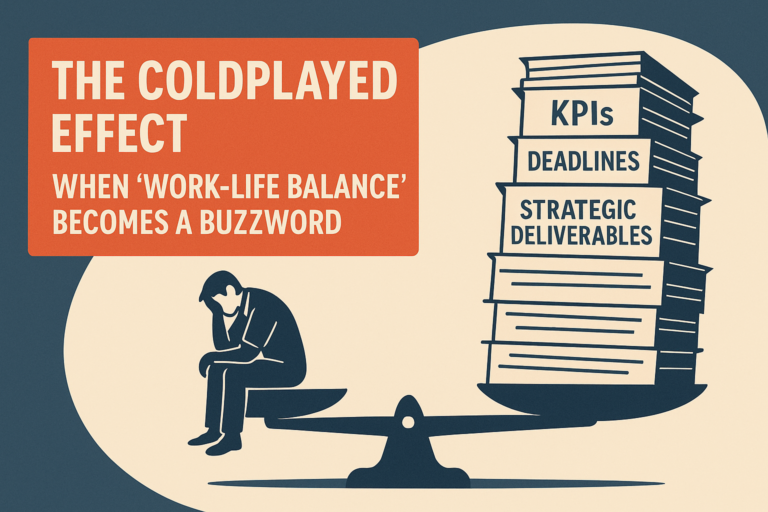
This is the ColdPlayed Effect: the widening distance between what an organization says and what people actually experience.
It is the corporate values gap with a bar chart.

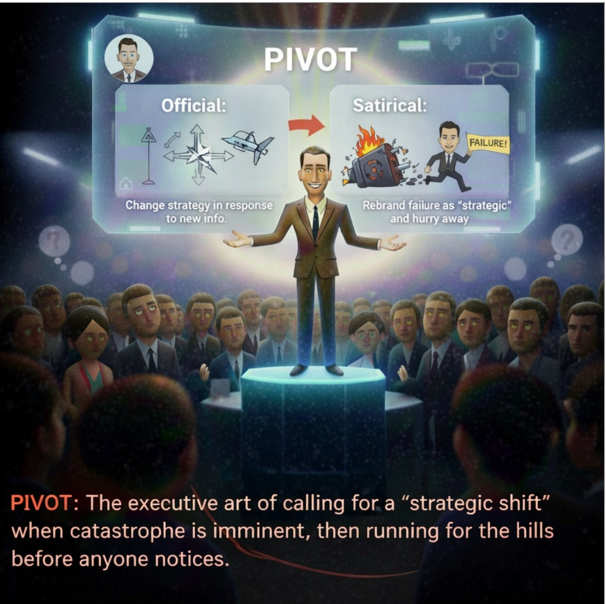
Official Meaning vs. Satirical Meaning
1. Employee survey
Official meaning:
A confidential opportunity for employees to share honest feedback and help improve the workplace.
Satirical meaning:
A digital suggestion box that feeds directly into a PowerPoint deck, where unpleasant comments are translated into “opportunities for alignment.”
What happens after the survey closes?
Do employees see the raw themes? Do leaders explain what they heard? Are specific actions assigned to specific people with specific deadlines?
Or does the feedback vanish into a spreadsheet graveyard, never to be seen again?
“We gave feedback three times. The only thing that changed was the color of the dashboard.”
That is not listening. That is data collection cosplay.
2. Engagement score
Official meaning:
A measurement of employee connection, commitment, satisfaction, and organizational health.
Satirical meaning:
A single number used to convince everyone that the culture is healthy enough to avoid uncomfortable questions.
A 92% satisfaction score might sound impressive. But 92% of what? Who responded? Who did not? Were results segmented by team, manager, tenure, location, or role?
Could one high-performing department be carrying the entire company’s score while another team is operating inside a psychological pressure cooker?
Averages are useful: but averages can also hide pain with the efficiency of a corporate magician.
3. Listening strategy
Official meaning:
A structured process for gathering, interpreting, and acting on employee input.
Satirical meaning:
A listening tour where leadership hears the feedback, thanks everyone for their bravery, and then returns to doing exactly what it planned to do anyway.
This is where values gaslighting enters the room.
Values gaslighting happens when employees are encouraged to trust the company’s stated values more than their own lived experience.
You say the workload is unsustainable. Leadership says, “Our data shows strong well-being.”
You describe retaliation after raising concerns. Leadership says, “Our culture scores are excellent.”
You point out that promotions favor the same inner circle. Leadership says, “We remain committed to fairness.”
At some point, the metric stops measuring reality and starts arguing with it.
When the Dashboard and Reality Split in Two
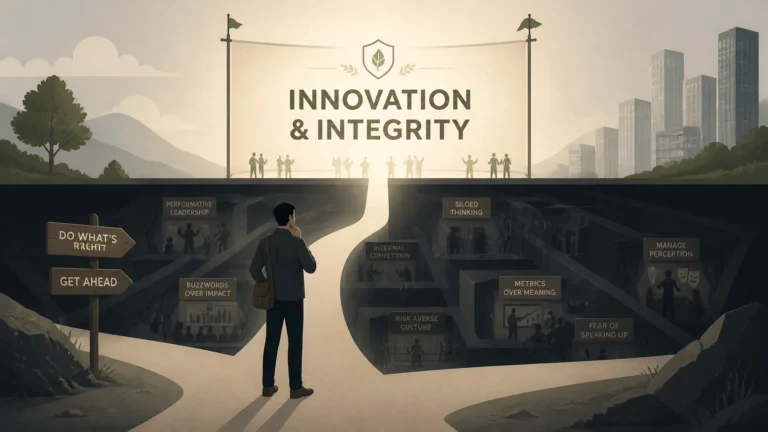
Picture the cartoon.
On one side, a giant green dashboard glows above the stage. Every arrow points upward. Every category is “trending positively.” A leader smiles beneath a banner that says People First.
On the other side, behind the screen, employees are carrying impossible workloads up a staircase marked “urgent,” “high priority,” and “quick turnaround.”
That is the visual language of workplace betrayal.
The organization tells you that your voice matters: then ignores what you said.
It tells you that psychological safety is a priority: then punishes the person who names the problem.
It tells you that leaders are listening: then uses your feedback to produce a cleaner slide deck.
Is it any wonder people stop answering honestly?
A high score can coexist with a toxic workplace culture when:
-
Employees do not trust anonymity.
If workers believe their manager can identify their responses, they may answer strategically. Silence becomes self-protection. -
The most distressed employees have already left.
Turnover can remove the people most willing to challenge the official story. The remaining workforce may be exhausted, cautious, or simply grateful to still have a paycheck. -
Leadership reports the headline, not the whole story.
“92% satisfaction” gets a font size of 64. The comments about bullying, burnout, favoritism, and retaliation get reduced to “mixed qualitative themes.” -
Managers are rewarded for positive results.
If a low score threatens bonuses, status, or career progression, what incentive exists to report the truth? The system quietly teaches leaders to polish the numbers. -
The survey asks about feelings but ignores behavior.
“I feel supported” is vague. “My manager follows through after I raise a concern” is observable. Corporate BS loves vague language because vague language is difficult to disprove.

When “Listening” Dies in a Spreadsheet
Listening is not the same as collecting.
A spreadsheet can tell you that satisfaction dropped three points. It cannot, by itself, tell you what it feels like to sit in a meeting where everyone is afraid to speak.
A dashboard can identify a trend. It cannot repair trust.
A town hall can display a word cloud. It cannot create authentic leadership unless leaders are willing to act on the words employees actually use.
This is why every serious culture conversation needs more than a score.
Look for:
- The exact questions asked
- Response rates
- Team-level differences
- Written comments and recurring themes
- Exit interview patterns
- Absenteeism and turnover
- Promotion and pay equity
- Follow-up actions
- Evidence that those actions were completed
If leadership refuses to show the method, context, or response plan, what exactly are employees being asked to trust?
A number without context is not clarity. It is decoration.
What You Can Do When the Numbers Do Not Match Reality
You may not control the company dashboard. You can still protect your understanding of what is happening.
1. Document the gap
Keep a private record of dates, decisions, commitments, workload changes, contradictory statements, and follow-up failures.
Do not rely on memory alone. Workplace betrayal often becomes harder to explain after months of being told that “nothing happened.”
A tool such as HeyPocket can help capture conversations, create summaries, and organize action items. If you use any recording feature, follow applicable laws and obtain consent where required. The goal is not surveillance. The goal is preserving reality when reality keeps getting rewritten.
2. Ask better questions
Instead of asking, “Do employees feel valued?” ask:
- What happened after employees raised concerns?
- Which commitments from the last survey were completed?
- What changed because of the feedback?
- Where are scores lowest?
- Who owns the corrective action?
- When will employees see progress?
Specific questions are kryptonite for corporate fog.
3. Compare words with behavior
Use the ColdPlayed test:
- Value: What does the company claim to care about?
- Behavior: What does it reward, tolerate, and punish?
- Impact: What does that produce for employees?
That three-part comparison exposes the corporate values gap faster than another culture slogan ever will.
4. Find support outside the stage
Read the ColdPlayed Effect book by Dr. Eric Fishon. Take the quiz and download the free guide on the 10 signs of toxic workplace culture.
You can also listen to the audio conversation featuring Dr. Eric Fishon on The Marblism Effect via Audible. Sometimes hearing another person name the pattern is the first moment you stop wondering whether you are imagining it.
And if you are looking for practical tools, savings, and partner resources, explore the Swamp Friends Savings Network. No productivity tool can fix a dishonest culture: but the right resources can help you organize, document, and make clearer decisions while you figure out your next move.
The Number Is Not the Culture
A 92% satisfaction score may be real.
It may also be incomplete, inflated, selectively presented, or completely disconnected from the people whose names are missing from the slide.
The point is not to reject every survey. Good measurement matters. Honest data can help leaders see problems early and make better decisions.
The point is to stop treating metrics as proof of integrity.
Authentic leadership is not the ability to display excellent numbers. It is the willingness to investigate uncomfortable numbers, hear painful stories, and change behavior when the evidence demands it.
That is the difference between measurement and metrics theater.
That is the difference between listening and performance.
And that is where the ColdPlayed Effect either continues: or ends.
Affiliate Disclosure
Some links in this post are affiliate links. If you purchase through an affiliate link, we may earn a commission at no additional cost to you. We only share tools and resources we believe may provide practical value. Affiliate relationships do not influence our criticism of corporate culture, workplace betrayal, or values gaslighting.
Now tell us:
Have you ever watched leadership celebrate a satisfaction score that had nothing to do with your lived experience?
Did your company turn serious feedback into a colorful dashboard and call it progress?
Share your ColdPlayed story with us. Your experience may help someone else name what happened: and it may be included in the upcoming book on the ColdPlayed Effect.