You know that feeling. It’s Monday morning, the fluorescent lights are humming with a clinical, soul-sucking intensity, and your manager pulls up a slide deck titled "Q3 Strategic Alignment."
Then, it happens. The pivot to the Objective.
It’s not a goal. It’s not a target. It’s a vibe. It’s a sweeping, multi-syllabic sentence that sounds like it was written by a chatbot that spent too much time reading Rumi and not enough time looking at a P&L statement. You feel that familiar tightness in your chest: the realization that for the next three months, you’ll be chasing a ghost.
Welcome to the world of Aspirational Poetry.
At Where the Rubber Meets The Road, we call this the "Metric Masquerade." It’s where leadership swaps out actual accountability for flowery language that looks great on a LinkedIn post but leaves the people actually doing the work wondering if they’re supposed to be hitting a number or finding their inner peace.
The OKR Glossary: Expectation vs. Reality
Before we dive into the wreckage, let’s check the vocabulary. In the high-gloss world of Silicon Valley management theory, OKRs (Objectives and Key Results) are the holy grail. But on the ground, in the trenches where the work actually happens, the definitions look a little different.
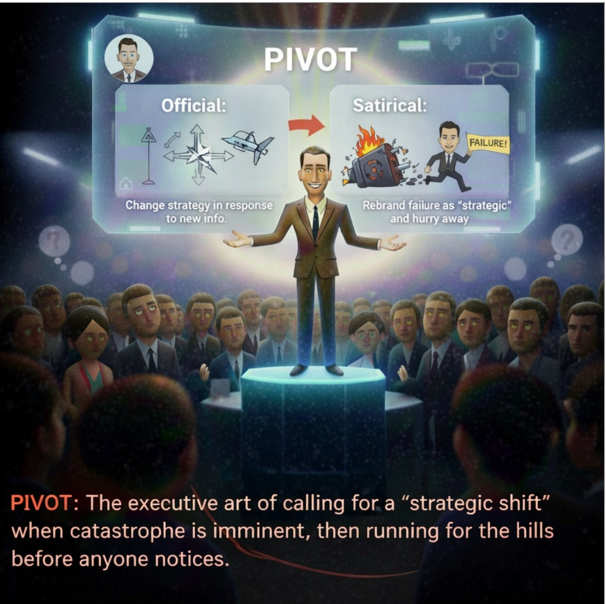
The Official Definition (The "Corporate Script"):
Objective: A qualitative, inspirational statement that defines a clear direction and empowers teams to innovate without prescribing the 'how.'
The Raw Reality (The "Satirical Truth"):
Objective: A vague, word-salad hallucination used by executives to avoid making hard decisions about what actually matters, usually involving the words "delight," "synergize," or "world-class."

Why Your Objectives Are Failing: 5 Signs You’re Dealing with Poetry
We recently tackled this on the podcast: OKRs: When Objectives Become Aspirational Poetry. If you’ve ever felt like your quarterly goals were more of a creative writing exercise than a business plan, you need to hear the full breakdown.
In the meantime, let’s look at how this poetry rots your culture from the inside out.
1. The "Adjective Overload" Trap
If your Objective requires more than three adjectives to explain what success looks like, you’ve already lost. We see this all the time: "Build a revolutionary, seamless, hyper-personalized digital ecosystem that empowers global stakeholders."
What the hell does that even mean? It’s not an objective; it’s a prayer. When the language is this fluffy, the team spends more time debating the meaning of "seamless" than they do building the product. It’s Algorithmic Gaslighting at its finest: using complex language to make you feel like the problem is your lack of vision, rather than their lack of clarity.
2. The Key Result that is Just a Task List
The "KR" in OKR is supposed to be a result. An outcome. Instead, most bosses treat them like a glorified To-Do list.
- Actual Key Result: Increase retention by 15%.
- Aspirational Poetry KR: "Launch the new customer portal."
Launching a portal isn't a result. It’s a task. You can launch a portal that everyone hates and that breaks the entire site. If your "Key Results" don't measure the impact of the action, you’re just doing Task Masking. You’re keeping busy while the ship is sinking.
3. The 70% "Success" Illusion
Google popularized the idea that hitting 60-70% of an "Aspirational OKR" is a win. In theory, this encourages "stretch goals." In practice? It’s a license to lie.
"Our OKRs are basically just a list of things we’ll never do, wrapped in language no one understands." : Direct quote from a senior dev during one of our recent culture audits.
When "failure" is baked into the system as "success," people stop taking the goals seriously. It becomes a game of "how high can I set the bar so that my 40% looks like 70%?" It turns the workplace into a theater of the absurd.

4. The "Delight" Factor
If the word "Delight" appears in your Objective, run. "Delighting customers" is a beautiful sentiment for a hallmark card. For a business objective? It’s a nightmare. You cannot measure delight. You can measure Net Promoter Score (NPS), churn rate, or repeat purchases. But when bosses use "Delight" as the primary objective, they’re usually using it as a shield to move the goalposts whenever they feel like it.
5. Strategic Drifting
When your objectives are poetry, they are open to interpretation. And interpretation leads to drift. One department thinks "Digital Transformation" means moving to the cloud; another thinks it means buying everyone new iPads.
Without a hard, cold metric anchoring the "Poetry," everyone rows in different directions while the CEO stands at the front of the boat reciting a sonnet about the "Horizon of Excellence."
The Cost of the Poetry: Culture Rot
This isn't just about bad management; it’s about the ColdPlayed Effect. When you feed your employees Aspirational Poetry instead of clear, raw truth, you breed cynicism.
You’ve seen it. The eye-rolls in the back of the room. The Slack messages in the "private" channels. People want to win. They want to know that their work matters. But you can’t win a game where the rules are written in metaphors.
When OKRs become motivational theater, your best people: the ones who actually give a shit about results: will be the first to leave. They don't want to be "empowered to innovate in a synergized landscape." They want to know what the target is so they can hit it.

How to Kill the Poetry and Get Real
So, how do we fix this? How do we take the OKR framework and actually make it work for leadership development? It starts with a radical commitment to the "Raw."
- The "So What?" Test: Read your Objective out loud. If someone asks "So what?" and your answer involves the word "vision," delete it and start over.
- Binary Key Results: Can you answer "Yes" or "No" to whether the result was achieved? If there's a "well, sort of…" involved, it’s poetry.
- Mandatory Minimalism: No more than three OKRs per team. If everything is an objective, nothing is.
- Connect it to the Podcast: Listen to our deep dive on this exact topic. We break down the specific frameworks we use to strip the bullshit out of strategy. Listen here on Amazon Music.
Is Your Team Living a Haiku or a Business Plan?
It’s time to stop the "Objective" theater. If you’re a leader, take a look at your current slide deck. Is it a roadmap, or is it a collection of "Aspirational Poetry"?
If your team spent the last quarter "striving for excellence" but your revenue is flat and your churn is up, you don't have a strategy problem. You have a poetry problem.
What’s the most "Aspirational" (read: BS) Objective you’ve ever been assigned? Tell us your stories in the comments or reach out via our contact page. Let’s start calling out the theater and getting back to where the rubber actually meets the road.

For more raw takes on workplace culture and leadership, check out our latest posts on the blog or take our culture quiz to see if your organization is currently being "AI-Washed."