You know the sound.
The soft ping of a Slack message after hours. The dry click of a conference-room door closing. The applause at a town hall where leadership just announced another “people-first initiative” , right before asking everyone to do more with less.
You nod. You smile. You type, “Love this!”
Meanwhile, something in your stomach says, Absolutely not.
Welcome to the ColdPlayed Effect: the toxic gap between what an organization says and what it actually does.
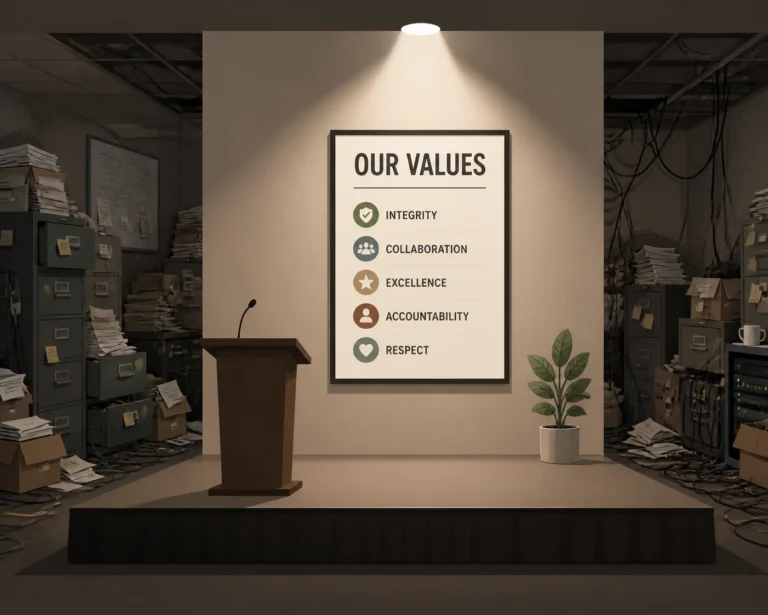
It is the moment corporate values become stage props. It is performance theater dressed up as leadership. It is the experience of being promised trust, belonging, authenticity, and well-being , then being punished for expecting any of those things to be real.
And if you have ever thought, “They said values mattered. Then they punished me for telling the truth,” you are not alone. That sentence represents a composite of the stories we hear from employees who have been ColdPlayed by their organizations.
The ColdPlayed Glossary: Let’s Name the Pattern
At Where the Rubber Meets The Road, we do not believe in hiding workplace dysfunction behind polished vocabulary.
Our ColdPlayed Glossary exists to translate the official language of corporate culture into the lived reality underneath it. You can explore the broader glossary here, but let’s establish a few definitions before we go further:
- Values Gaslighting: When an organization uses its stated values to make you doubt your own experience. You raise a concern about hypocrisy, and suddenly you are the problem.
- Performance Theater: Visible displays of culture , town halls, posters, workshops, surveys, branded campaigns , that create the appearance of progress without changing how decisions are made.
- Corporate Values Gap: The measurable distance between the values printed on the wall and the behaviors rewarded in practice.
- Workplace Betrayal: The emotional injury created when an organization breaks promises it used to earn your trust.
- Authenticity Advocate: Someone willing to align words, decisions, and consequences , even when doing so is inconvenient or expensive.
These terms matter because unnamed experiences are easy to minimize. Once we name the pattern, we can examine it.
Official vs. Satirical: The Corporate Culture Translation Guide

1. “We are a family.”
Official meaning: We care about one another and support our people.
Satirical meaning: We would like the emotional loyalty of a family without the legal, financial, or moral obligations.
A real family does not typically announce a restructuring through a three-minute video featuring inspirational music and employees hugging in slow motion. A real family does not tell you that your role is “mission-critical” on Monday and eliminate it by Friday because the spreadsheet changed.
The company family metaphor becomes dangerous when it pressures employees to accept poor boundaries, unpaid emotional labor, or loyalty without reciprocity.
Ask yourself: Is “family” being used to create belonging , or to make you feel guilty for expecting fair treatment?
2. “Bring your authentic self to work.”
Official meaning: You are welcome as a whole person.
Satirical meaning: Bring your authentic self, provided that self is agreeable, quiet, endlessly resilient, and never points out executive hypocrisy.
This is where values gaslighting gets especially nasty.
You are encouraged to speak openly , until your openness challenges power. You are invited to share feedback , until the feedback becomes uncomfortable. You are told that vulnerability is a strength , until your vulnerability exposes a broken system.
Then comes the corporate translation:
- “You are not aligned with our culture.”
- “Your tone is concerning.”
- “Maybe this is not the right environment for you.”
- “We need people who are solutions-oriented.”
Sometimes “solutions-oriented” simply means please stop describing the problem so accurately.
3. “We listen to our employees.”
Official meaning: Feedback informs decisions.
Satirical meaning: We collect your feedback, place it in a beautifully designed dashboard, and let it die there.

An employee survey can be useful. A listening session can be valuable. An open-door policy can mean something.
But tools are not culture.
The real test is what happens after employees tell the truth. Are difficult findings acknowledged? Are leaders held accountable? Do policies change? Are people protected from retaliation?
Or does the company launch a new “listening tour” because it is easier to schedule another listening tour than to address what employees already said?
4. “We prioritize well-being.”
Official meaning: Employee health matters.
Satirical meaning: Here is a meditation app. Now please answer these emails at 11:30 p.m.
No amount of branded wellness programming can compensate for unreasonable workloads, unstable leadership, chronic understaffing, or a workplace where taking time off is treated like a character flaw.
The Kombucha Cure-All is one of our favorite examples of this corporate trick: offering snacks, yoga, or resilience training while leaving the actual sources of distress untouched. (Nothing against kombucha. It simply cannot repair a broken power structure.)
5. “We operate with integrity.”
Official meaning: We do the right thing, especially when it is difficult.
Satirical meaning: We do the right thing when legal, reputational, and financial conditions are favorable.
Integrity is not a slogan. It is a pattern of decisions.
It appears in who gets promoted, who gets protected, whose misconduct gets investigated, whose concerns get buried, and whether leaders apply the same rules to themselves that they apply to everyone else.
That is where the rubber meets the road.
Five Signs You Are Looking at Performance Theater
The corporate values gap is not always obvious at first. Sometimes it arrives wearing a nice blazer and carrying a color-coded strategic plan.
Here are five signs the theater may be replacing the culture:
-
The company celebrates values more than it measures them.
There are posters, slogans, and leadership speeches : but no clear evidence of how values influence hiring, promotions, compensation, or discipline. -
Bad news is treated as disloyalty.
Employees who raise concerns are labeled negative, difficult, or “not a culture fit.” Why is honesty welcomed only when it sounds flattering? -
Leaders explain away contradictions instead of repairing them.
The issue is reframed as a misunderstanding, communication problem, or isolated incident : even when the pattern is obvious. -
The burden of adaptation always falls downward.
Employees are told to be more resilient, flexible, collaborative, and positive while leadership avoids changing the conditions causing the harm. -
The loudest culture champions behave differently behind closed doors.
The executive who speaks passionately about respect may interrupt everyone. The leader promoting transparency may punish dissent. The department preaching inclusion may quietly exclude anyone who challenges the inner circle.
That is not culture.
That is a costume department.
What Employees Can Do When the Script Stops Matching Reality
If you are living inside a toxic workplace culture, you do not have to solve the entire organization overnight. Start by creating reality anchors.
-
Write down the stated value and the observed behavior.
For example: “Transparency” versus a decision made in secret. “Respect” versus public humiliation. This helps interrupt the effects of values gaslighting. -
Document facts, not just feelings.
Keep dates, messages, decisions, commitments, and follow-up failures. Documentation cannot guarantee justice, but it can protect your clarity. -
Find people who deal in specifics.
Look for colleagues who can distinguish between “This feels wrong” and “Here is what was promised, what happened, and who was affected.” -
Set boundaries where you can.
You are allowed to ask for priorities, timelines, written expectations, and honest explanations. You are allowed to stop volunteering your entire nervous system to a company that gives you a branded water bottle in return. -
Build options before you need them.
Update your résumé, reconnect with trusted contacts, and explore healthier workplaces. Leaving is not failure. Sometimes it is the clearest evidence that you finally believe yourself.
If you want a structured starting point, take the free Have You Been ColdPlayed? quiz or download the 10 Signs You’re in a ColdPlayed Culture guide.
What Leaders Can Do Instead
Leaders who genuinely want authentic leadership have to retire the performance and tolerate the truth.
That means:
- Connect values to actual decisions, budgets, promotions, and consequences.
- Admit when the organization has failed instead of launching another campaign.
- Protect employees who raise legitimate concerns.
- Measure whether people experience the culture as intended : not merely whether they can recite the values.
- Make accountability visible, especially at the top.
- Replace vague corporate language with clear commitments and owners.
- Ask, “What would employees point to as proof?” Then provide that proof.

Authentic culture is not a perfect workplace. It is a workplace where the distance between the promise and the practice is small enough to trust.
That is the standard.
The Book Behind the Movement
Dr. Eric Fishon’s book, The ColdPlayed Effect: How Corporate Culture Became a Lie We Lived With : and How to Break Free, pulls back the curtain on corporate BS, toxic leadership, workplace betrayal, and the emotional cost of working inside a values-performance disconnect.
It is not just a book about complaining about bad bosses. It is about recognizing the pattern, healing from organizational betrayal, and building a more honest model of leadership.
Visit coldplayedeffect.com to learn more, take the quiz, download the free guide, and join the movement for values that are lived : not marketed.
You can also listen to an audio conversation through Amazon Music.
Affiliate disclosure
The following links are affiliate links. If you make a purchase or sign up through them, we may earn a commission at no additional cost to you. We only share them as resources we believe may be useful.
- HeyPocket is a personal AI assistant designed to capture conversations, create summaries, and organize action items.
- ABCO Extermigator’s Swamp Friends Savings Network features partner tools, discounts, and savings opportunities. A portion of affiliate commissions may support the network’s charitable mission.
The disclosure is simple because it should be: no smoke, no mirrors, no fake neutrality.
So where have you seen the corporate values gap in action?
Have you been told to “speak up” and then punished when you did? Did your company turn authenticity, well-being, or integrity into a polished little stage show?
Share your story with us. We are collecting real experiences for the upcoming book and the growing ColdPlayed movement.
What was the promise ; and what actually happened?