You know the sound.
The cheerful chime of a company-wide Zoom meeting. The fluorescent buzz above your desk. The click of a CEO’s remote as another slide appears with INTEGRITY, EMPATHY, and INNOVATION in enormous letters.
Then comes the familiar feeling: a tightness in your chest, a slow roll in your stomach, the quiet realization that the company preaching well-being just sent three “urgent” emails at 10:47 p.m.
You stare at the screen and think:
“Are we actually doing this again?”
Welcome to the performance disconnect: the gap between what a company says it values and what it actually rewards, tolerates, and does when the pressure hits.
At Where the Rubber Meets The Road, we have another name for it: The ColdPlayed Effect.
It’s what happens when corporate culture becomes a costume. The values look impressive under the stage lights, but the person wearing them keeps acting like nobody can see the seams.
The ColdPlayed Vocabulary: Official vs. Satirical Reality
Before we pull back the curtain, let’s establish the language.
Our ColdPlayed Vocabulary uses an official vs. satirical framework because corporate language often has two meanings: the one printed in the handbook and the one employees learn through lived experience.
| Official Corporate Meaning | Satirical Reality |
|---|---|
| Core Values: Principles that guide behavior and decisions. | Lobby wallpaper designed to look ethical while leadership does whatever protects the numbers. |
| Authenticity: Being honest and true to yourself. | Pretending to be yourself in a way that remains acceptable to the company brand. |
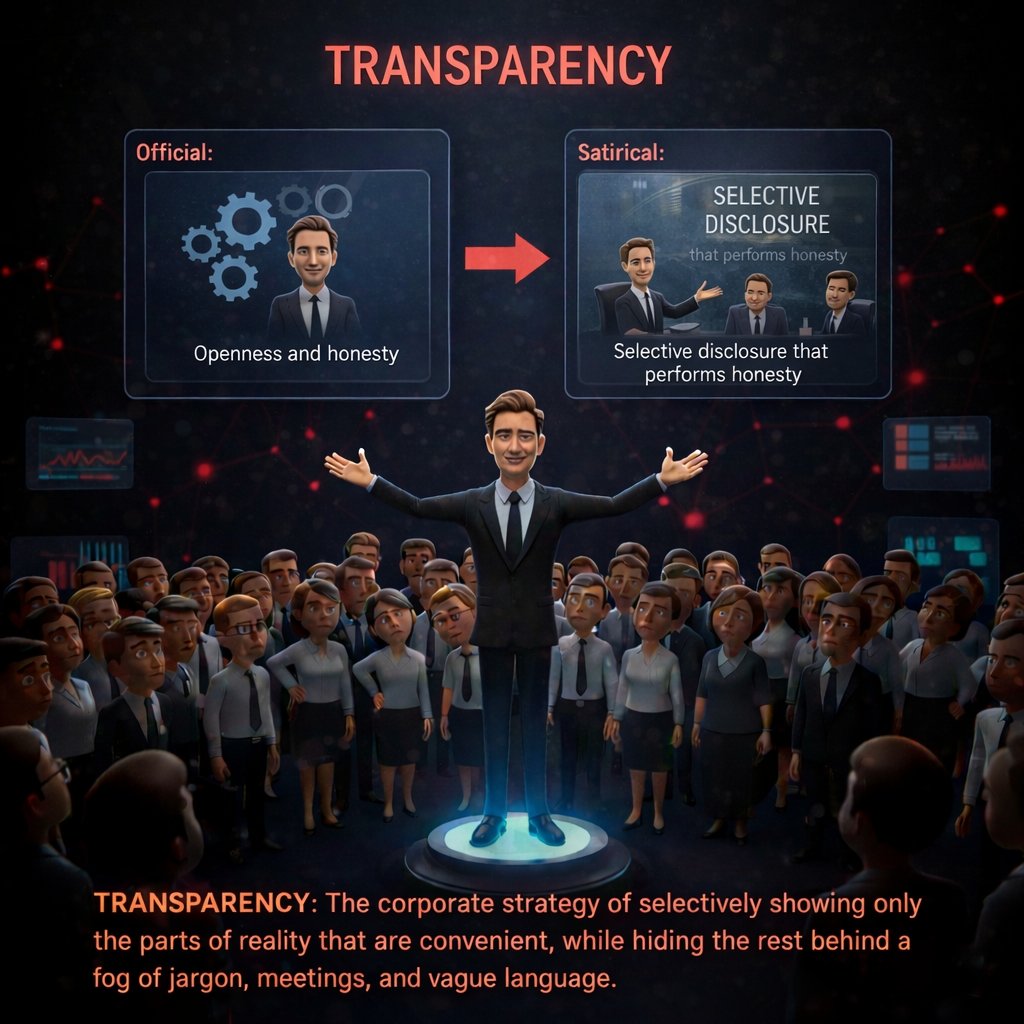
| Transparency: Open and honest communication. | Selectively sharing information after the important decisions have already been made. |
| Empowerment: Giving employees authority and resources. | Handing someone three new responsibilities and calling it a growth opportunity. |
| Work-Life Balance: Protecting employees’ personal well-being. | A beautiful phrase used by leaders who email on Sunday morning. |
See the problem?
The official definition tells you what the organization wants you to believe. The satirical definition tells you what the system has trained you to expect.

What the Performance Disconnect Really Means
A values statement is not culture.
A poster is not culture. A town hall is not culture. A leadership off-site with branded notebooks and a catered lunch is definitely not culture.
Culture is what happens when nobody is presenting.
It lives in the promotion decision. The denied vacation request. The manager who gets protected after mistreating employees because they “deliver results.” The worker who raises an ethical concern and suddenly becomes “not aligned.”
Research and workplace practice have repeatedly pointed to the same truth: values only matter when they influence real decisions. If integrity disappears the moment revenue is threatened, integrity was never the operating value.
The real value was revenue.
If collaboration is printed on every wall but individual employees are rewarded for hoarding information, the real value is internal competition.
If well-being is celebrated in a wellness webinar while chronic overwork is treated as commitment, the real value is exhaustion.
That is the values-performance disconnect. And when leadership insists the disconnect does not exist, the damage becomes something more severe: workplace betrayal.
4 Ways Companies Turn Values Into a Costume
Why does this happen? Why do organizations spend so much time describing the culture they want while ignoring the culture they create?
1. They choose values that cannot be challenged
Integrity. Innovation. Excellence. Respect.
These words sound admirable. They also sound like they were selected by a committee that feared saying anything specific.
A useful value should help employees make a difficult decision. It should answer questions like:
- Do we tell the customer the truth when the truth costs us the sale?
- Do we protect a burned-out employee when a deadline is approaching?
- Do we hold a high-performing executive accountable when they damage the team?
- Do we reward the person who raises a concern: or punish them for making leadership uncomfortable?
If the value cannot survive a trade-off, it is not a value. It is branding.
2. They reward behavior that contradicts the mission
This is where the costume begins to tear.
The company says it values respect, but the most disrespectful manager keeps getting promoted.
It says it values teamwork, but the person who takes credit for everyone else’s work receives the bonus.
It says it values psychological safety, but employees learn that honest feedback is remembered during performance reviews.
What do people believe: the slide deck or the promotion list?
Exactly.
Employees watch what happens to other people before they decide how honest they can afford to be. Every exception teaches the workforce what the company really values.
3. They use mission language to extract more labor
“We’re all in this together.”
“Our customers are counting on us.”
“This is bigger than any one person.”
Sometimes those statements are sincere. In a ColdPlayed culture, they become emotional leverage.
The mission becomes a guilt machine. Boundaries become evidence that you are not committed. Exhaustion becomes a badge of honor. And “family” becomes a way to ask employees for sacrifices the company would never make for them.
“I used to think I was the problem. I thought if I just worked harder, I’d finally feel ‘included.’ Then I read about the ColdPlayed Effect and realized the game was rigged from the start.”
That is not a motivation problem. That is a trust injury.
4. They confuse communication with accountability
A company can communicate constantly and still tell employees nothing.
There can be newsletters, listening sessions, pulse surveys, culture committees, leadership podcasts, and enough “check-ins” to bury an entire department.
But if the same problems keep happening, communication is being used as a substitute for action.
Transparency without consequences is just theater with better lighting.
How to Tell Whether Your Company’s Values Are Real
You do not need to launch an internal investigation or decode every executive email. Start by watching the patterns.
Here are five questions worth asking:
-
Who gets promoted?
Do leaders advance because they model the stated values, or because they are good at managing up and managing the damage? -
What happens when someone speaks up?
Is dissent treated as useful information: or as a threat to the company’s image? -
What gets measured?
Are employees evaluated only on output, or also on how they treat colleagues, customers, and direct reports? -
Who gets protected?
When a powerful person causes harm, does the organization investigate honestly or quietly rearrange the blame? -
What happens under pressure?
Values are easiest to perform when everything is going well. The truth appears during layoffs, missed targets, customer complaints, and leadership mistakes.
If the answers make you uncomfortable, pay attention to that discomfort. It may be the first honest data your workplace has given you in months.
You can also take the free ColdPlayed workplace quiz to identify whether you are experiencing a toxic workplace culture, sitting in the observer position, or trying to lead with authenticity inside a broken system.
And download the free “10 Signs You’re in a ColdPlayed Culture” PDF guide. It includes reflection questions and practical ways to protect your peace, power, and integrity.
How Leaders Can Take Off the Costume
This is not just an employee problem.
Leaders who genuinely want authentic leadership have to stop asking whether the values sound good and start asking whether the systems make those values possible.
That means:
-
Define observable behaviors.
Do not say “respect.” Explain what respectful disagreement, feedback, scheduling, and decision-making look like. -
Tie values to promotions and bonuses.
If someone delivers spectacular numbers while humiliating their team, the organization must stop calling that person a cultural fit. -
Tell the truth sooner.
Employees can handle difficult news better than they can handle polished deception followed by a surprise betrayal. -
Accept the cost of integrity.
A value that costs the company nothing has not been tested. -
Invite evidence, not applause.
Ask employees where the company’s behavior contradicts its stated values: and do not punish them for answering.
For employees, practical protection matters too. Document contradictions. Keep important communication. Build relationships outside the immediate chain of command. Clarify expectations in writing.
And if the culture is affecting your financial or emotional ability to leave, tools that help you organize your personal life and build breathing room can matter. You can explore HeyPocket as one option for managing your finances and planning your next move.
For the literal pests that show up around homes and businesses while you are dealing with the corporate ones, the ABCO Extermigator Swamp Friends Savings Network may also be useful. (Because apparently some environments come with both metaphorical snakes and actual insects.)
The Book, the Podcast, and the Reckoning
Dr. Eric Fishon’s The ColdPlayed Effect gives language to the experience many employees have struggled to explain: the emotional damage created when organizations promise one reality and deliver another.
You can check the Amazon listing for The ColdPlayed Effect and search Audible for Dr. Eric Fishon for current availability and formats.
For the broader conversation, listen to Where the Rubber Meets The Road on Amazon Music, where corporate language, workplace jargon, leadership, and culture get the forensic audit they deserve.
Because the goal is not simply to complain about bad bosses.
The goal is to recognize the pattern, stop blaming yourself for the contradiction, and build organizations where the rubber actually meets the road.
Take Off the Mask
Your company’s values may be real. They may also be a costume carefully tailored for investors, customers, candidates, and LinkedIn.
The difference is visible in the consequences.
Watch what happens when the mission becomes inconvenient. Watch who gets believed. Watch who gets promoted. Watch whether the people who raise concerns are treated as contributors: or contaminants.
That is where the truth lives.
Have you seen a company value collapse under pressure? What did the organization say publicly, and what did it actually do?
Share your story with us for the upcoming book on The ColdPlayed Effect. Your experience may help someone else realize they were not imagining the gap( they were living inside it.)