
The “Growth Mindset” Mirage: When Personal Development Masks Systemic Decay
We’ve all been encouraged to cultivate a “growth mindset.” It’s plastered on office walls, extolled in workshops, and woven into the very fabric of corporate language. The idea, in theory, is empowering: embrace challenges, learn from failures, and continuously strive for improvement. But what happens when this focus on individual growth becomes a convenient distraction from deeper, systemic issues? What happens when the “growth mindset” is just another tool in the “Coldplayed” playbook?
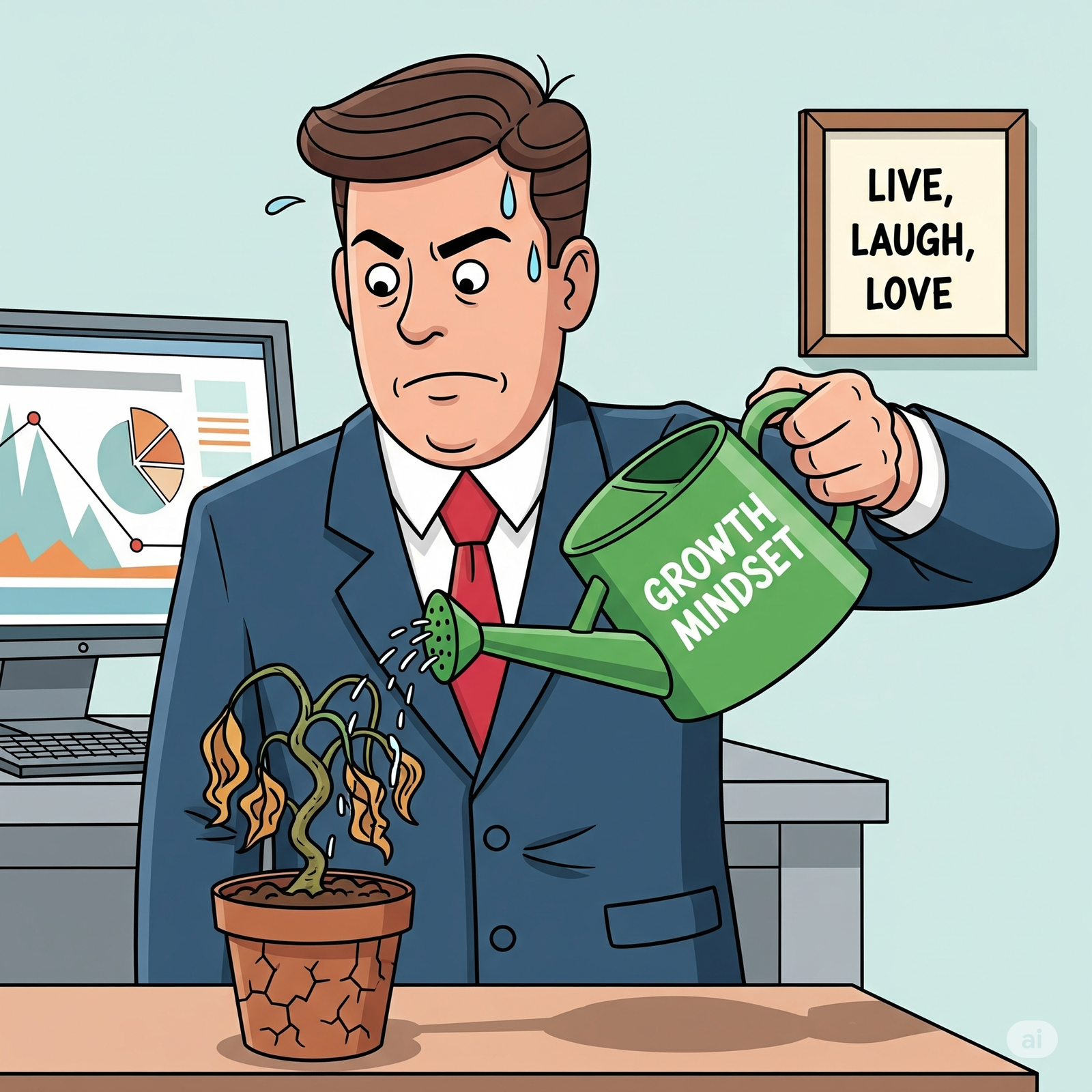
Take a close look at the image above. Here we see an enthusiastic, albeit misguided, employee diligently watering a clearly withered plant with a watering can labeled “Growth Mindset.” Meanwhile, a single, healthy sprout struggles to emerge from the parched soil. This perfectly encapsulates the paradox we often see in the corporate world
The Symptoms of the Mirage:
- Individual Blame, Systemic Issues: In a “Coldplayed” environment, the lack of progress or success is often attributed to an individual’s lack of a “growth mindset.” Missed targets? Didn’t innovate enough? Didn’t “lean in” effectively? The responsibility lies primarily with the employee, diverting focus away from issues such as flawed processes, inadequate resources, or toxic leadership.
- Ignoring the Dying Plant: The withered plant in our image represents the fundamental problems within the company culture or specific projects. These could be anything from outdated technology and unrealistic workloads to poor communication and a lack of genuine support. Instead of addressing these core issues represented by the dying plant, the focus shifts to attempting to force individual growth, as if watering with the “Growth Mindset” can serve as a magical cure-all.
- The Token Sprout of Hope: The single healthy sprout is often highlighted as proof that the “growth mindset” approach is working. This allows the company to point to isolated successes while conveniently ignoring the widespread stagnation and decay.
- The Pressure to Perform Positivity: Employees are not only expected to achieve more but also to maintain a relentlessly positive attitude while doing so. Expressing frustration or pointing out systemic problems can be considered a failure to embrace the “growth mindset” itself, further silencing crucial feedback.
The Coldplay Distortion:
The “growth mindset,” when genuinely fostered, can be a powerful tool for personal and professional development. However, in a “Coldplayed” workplace, the growth mindset becomes a distorted expectation—a means to demand more from employees without providing the necessary support or addressing underlying problems. It’s a performance of optimism that demands resilience in the face of preventable adversity.
Conclusion:
While personal growth is essential, it cannotit cannot flourish in barren soil. True progress requires an honest assessment of the environment. Before we’re all instructed to water our metaphorical plantsmetaphorical plants with enthusiasm, perhaps it’s time to examine the soil, identify the withered roots, cultivatecultivate workplace where genuine growth—both individual and systemic—can truly take hold

The Coldplayed Challenge of the Week
- Your Challenge: Challenge: This week, we’re examining the language of self-improvement using a key term from our book’s glossary.
This Week’s Word: Pivot
- Official Meaning: To change a strategic direction in response to new information.
- Real Meaning: To admit a failed idea was a “learning experience” and move before anyone can blame you for it
Share Your Story: Have you ever been encouraged to adopt a “growth mindset” to overcome obstacles that were clearly beyond your control? Share your experiences with corporate “pivots” or any instances where individual responsibility was emphasized over systemic change in the comments below or on social media using the hashtag #ColdplayedEffect.
Win an Early Copy: Every person who shares a story will be entered to win a free, early digital copy of “Beyond the Boardroom.”