RUN IT UP THE FLAGPOLE
ColdPlayed Effect Vocabulary (for thecoldplayedeffect.com/vocabulary and the upcoming book Beyond the Boardroom)
If you have spent enough time in conference rooms (or, more realistically, in a calendar invite titled “Quick Sync”), you have heard it:
“Let’s run it up the flagpole.”
It usually arrives dressed as collaboration—friendly, low-stakes, and “just exploring.” But in practice, it can mean anything from “please validate my idea” to “I would like to outsource the risk and keep my hands clean.”
This is precisely why it belongs in The ColdPlayed Effect vocabulary: the phrase sounds like leadership, yet often functions like a decision-delay mechanism with a patriotic accent.
RUN IT UP THE FLAGPOLECategory: Workplace Vocabulary / Corporate Jargon / ColdPlayed Effect
Best used when: Someone wants “feedback” without commitment—or wants you to own the risk.
Also appears in: Beyond the Boardroom (upcoming)
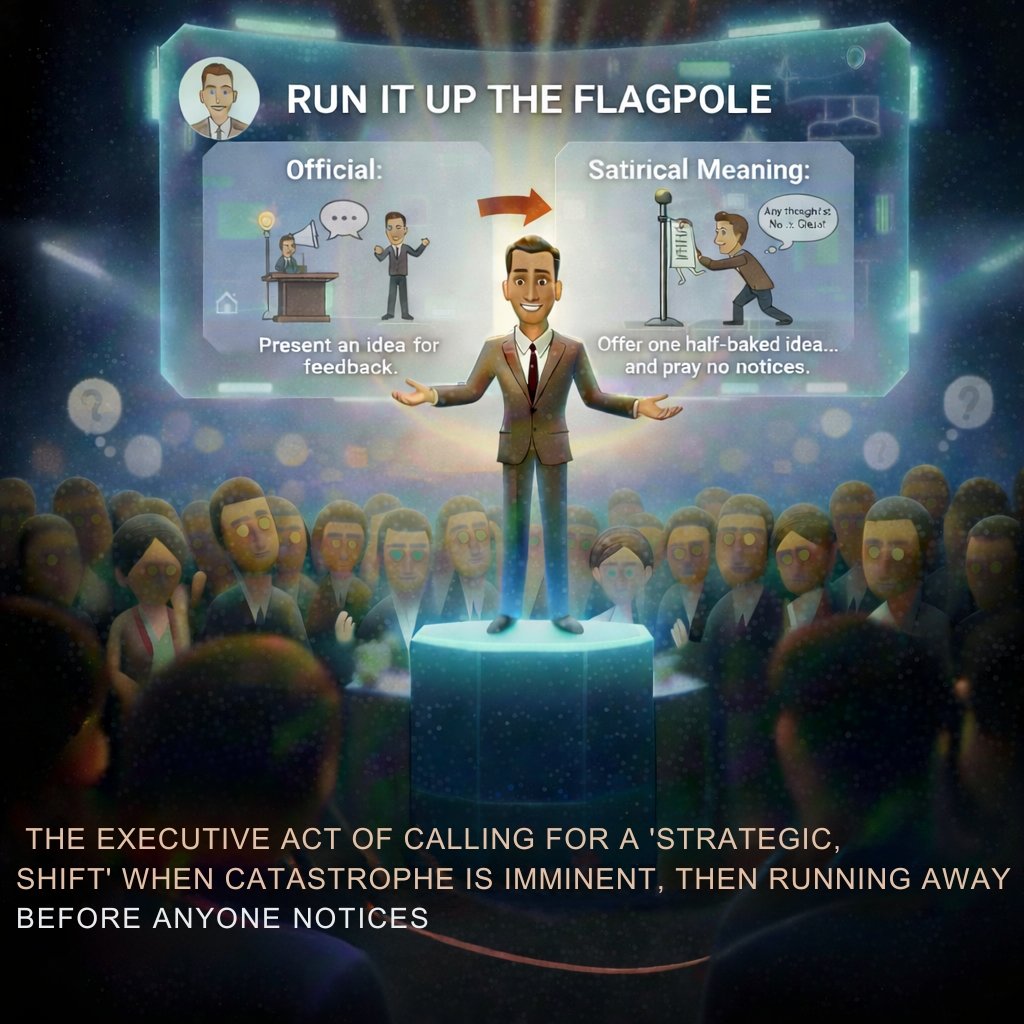
Official Definition
A phrase used to float an idea to others to gauge reactions, interest, or approval before formally committing to it.
Satirical Definition (ColdPlayed Effect)
The executive move of calling for a “strategic shift” when trouble is brewing—then backing away while everyone else carries the confusion, the risk, and the follow-up.
What It Sounds Like vs. What It Usually Means
What it sounds like:
- “Let’s collaborate.”
- “Let’s pressure-test.”
- “Let’s explore together.”
What it often means:
- “I want validation, not critique.”
- “I don’t want to own the decision yet.”
- “I’d like you to socialize this so I can say ‘we aligned.’”
“If it fails, I want it to look like a team idea.”
Where You Hear It (and the Translation)
1) When the meeting is stuck
Translation: “We need movement, but no one wants responsibility.”
2) When a leader wants buy-in without debate
Translation: “Tell me it’s good—politely—so I can proceed.”
3) When ‘feedback’ is actually pre-approval
Translation: “Support this publicly, and critique it privately (if at all).”
4) When a crisis is looming
Translation: “I want options on paper—just in case—without making the hard call.”
The ColdPlayed Flagpole Test (3 Questions That Protect You)
Before you “run it up the flagpole,” ask:
Who is the decision owner?
If nobody owns it, you are being invited into responsibility-by-default.
What are we testing—feasibility, appetite, budget, or risk?
If the ask is vague, the outcome will be vague (and used selectively).
What does success look like—and by when?
Without criteria and a deadline, this becomes a permanent loop.
Professional Responses That Keep You Safe (and Still Collaborative)
Use any of these to turn fog into clarity:
Clarify the test:
“Happy to float it—what specifically are we testing: feasibility, budget impact, stakeholder appetite, or risk?”
Name ownership:
“Before I socialize it, who is the decision owner and what’s the approval path?”
Timebox the loop:
“Let’s do a quick pulse with the key stakeholders this week and decide by Friday.”
Better Alternatives (If You Actually Mean Collaboration)
If your intent is genuine feedback, try:
“Let’s run a quick stakeholder pulse: here’s the proposal, here are the tradeoffs, and here’s the decision date.”
Same collaboration. Less fog. More trust.
The ColdPlayed Effect Takeaway
“Run it up the flagpole” isn’t always bad. In a healthy culture, it simply means early feedback.
But in a ColdPlayed culture, it becomes a fog machine—movement without commitment, alignment without clarity, and strategy without ownership.
If you hear it this week, do not argue. Do not roll your eyes.
Ask for three things:
Owner. Criteria. Decision date.
CTA (Website Footer Block)
Explore more corporate translations at:
https://www.thecoldplayedeffect.com/vocabulary
And watch for the upcoming book:
Beyond the Boardroom — where workplace phrases get decoded into what they really do to teams.
That is how satire becomes strategy.
Related Vocabulary
- “Circle Back”
- “Strategic Pivot”
- “Alignment”
- “Socialize This”
- “Table It”
- “High-Level”
Define the ‘salute’:
“What does a ‘yes’ look like here—three stakeholder approvals, a cost threshold, or a measurable outcome?”
Crisis-proof it:
“Understood. What’s the immediate problem we’re solving, and what are we deferring until stability returns?”