The Slack notification lands at 7:03 a.m.
“Quick question.”
Your stomach tightens before you even open it.
Then comes the meeting where your manager says, “We’re a family,” right before asking you to absorb another person’s workload. The cheerful values deck flashes across the screen. Integrity. Belonging. Well-being.
Meanwhile, someone who humiliates the team keeps getting rewarded because they “deliver.”
You know that feeling, don’t you?
The sense that the company sold you one workplace and quietly delivered another.
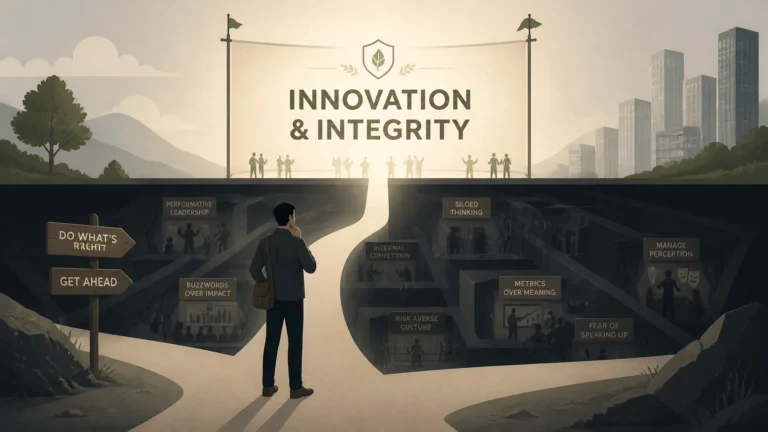
In the language of our ColdPlayed Glossary, this is the beginning of the ColdPlayed Effect: the painful gap between what an organization says and what it actually does.
Getting ColdPlayed is not one bad meeting. It is a five-stage career experience: almost like grief, except the thing you are grieving is your belief in the company.
Here is how it usually unfolds.
The five stages of getting ColdPlayed
1. The Audition: “You’re exactly who we’ve been looking for”

Official version
The hiring process is presented as a mutual fit.
The company tells you it values authentic leadership, collaboration, flexibility, and growth. The interview feels unusually warm. Leaders talk about transparency. The recruiter describes the team as supportive and “like a family.”
You leave believing you found more than a job. You found a place where your contribution will matter.
Satirical version
Welcome to The Audition, where the company performs its best behavior before you sign the paperwork.
The values are polished. The leadership smiles. Everyone has a story about how much they care.
No one mentions the hidden script:
- “Work-life balance” means answer messages at night.
- “Ownership” means inherit problems without authority.
- “Growth opportunity” means do two jobs for the salary of one.
- “Family” means emotional loyalty without organizational loyalty.
The first stage is not always a lie. That is what makes it dangerous. Some leaders genuinely believe the marketing. Others know exactly what they are selling.
Either way, you walk in carrying hope.
That is not stupidity. That is what a healthy employee is supposed to bring to work: trust, effort, and a willingness to contribute.
2. The Immersion: The values look real: at first
You start the job. There is onboarding. Maybe a branded hoodie. A welcome meeting. A slide deck explaining the organization’s corporate values in large, friendly type.
You learn the rituals:
- Say “we” constantly.
- Praise the mission.
- Smile through ambiguity.
- Call exhaustion “passion.”
- Treat every leadership request as a development opportunity.
Official version
You are joining a purpose-driven culture. Everyone is aligned. The company is committed to people.
Satirical version
You have entered the theme park.
There is a values poster in every hallway, but the actual rules are distributed through whispers, closed-door meetings, and who gets forgiven.
This is where performance theater begins to replace honest culture. The company does not need everyone to believe the values. It only needs everyone to repeat them convincingly enough to keep the machinery running.
You may notice small inconsistencies:
- A leader preaches respect, then mocks an employee in public.
- A company promises inclusion, then ignores the same three voices in every meeting.
- A manager talks about empowerment while approving every minor decision.
- HR invites feedback, but nobody can explain what happened after the last survey.
You tell yourself it is temporary.
Every workplace has flaws, right?
That question can keep us trapped for years.
3. The Fracture: The corporate values gap becomes impossible to ignore

The fracture usually arrives through a decision.
A promotion goes to the person who causes the most damage. A high performer is protected after violating every stated standard. A restructuring eliminates the people who raised concerns while leadership praises “psychological safety.”
This is the moment the corporate values gap stops being theoretical.
Official version
The company explains that decisions are complex. There are business realities. Leaders had to make difficult choices.
Satirical version
The values remain sacred: right up until they become inconvenient.
Then:
-
Results outrank behavior.
The toxic “rock star” is too valuable to hold accountable. -
Loyalty becomes a one-way contract.
Employees are expected to sacrifice, but the organization offers no meaningful reciprocity. -
Context becomes a corporate fog machine.
Every contradiction is explained until the contradiction disappears from the official record. -
The burden moves to the employee.
If you are upset, you need coaching. If you are burned out, you need resilience training. If you object, you need to be “more strategic.”
You may hear:
“That’s just how they are.”
“You’re taking it personally.”
“Maybe you’re not being adaptable enough.”
That is values gaslighting: when an organization denies the obvious mismatch between its stated principles and your lived reality.
You are not imagining the contradiction because the company used the word “culture” in a presentation.
4. The Betrayal: When the story turns against you
Betrayal is different from disappointment.
Disappointment says, “This did not work out.”
Betrayal says, “You told me one set of rules applied here: and then punished me for believing you.”
This stage can feel like digital death by a thousand cuts:
- Your concerns are documented as an “attitude issue.”
- Your boundaries become evidence that you are not committed.
- Your directness is labeled negativity.
- Your accomplishments are quietly reassigned.
- Your questions make people uncomfortable, so you become the problem.
Official version
The organization says it is addressing performance, alignment, or team dynamics.
Satirical version
The company has discovered a miraculous process called accountability, which somehow only points downward.
You may begin questioning your own memory. Did the manager really promise that? Was the promotion criteria always this vague? Did the company ever say “flexibility,” or did you project that onto a carefully worded recruiting page?
This is why documentation matters: not because you should live like a corporate spy, but because workplace betrayal can distort your confidence.
Keep factual records:
- Date and time
- Who was present
- What was said
- What decision was made
- What action was assigned
- What changed afterward
A tool such as HeyPocket can help capture notes, summaries, and action items from conversations so you are not relying on a stressed, exhausted memory. Use any recording or transcription feature only with appropriate consent and in compliance with applicable laws and workplace policies. A written follow-up email can be just as powerful:
“To confirm my understanding, we agreed that X would happen by Friday, and Y would remain the priority.”
That is not paranoia. That is clarity.
5. The Reckoning: Reclaiming your power
The reckoning is not necessarily the day you quit.
Sometimes it is the day you stop asking a dishonest system to validate your reality.
You may stay and set boundaries. You may transfer teams. You may consult an employment professional. You may leave. You may build something better.
The point is not to make one dramatic move for social media. The point is to stop surrendering your identity to an organization that confused obedience with belonging.
What reclaiming your power can look like
-
Name the pattern.
Call it the ColdPlayed Effect instead of blaming yourself for failing to adapt to hypocrisy. -
Separate your worth from the workplace.
A bad review, layoff, or exclusion from the inner circle is not a complete assessment of your ability. -
Build an evidence trail.
Save performance feedback, project outcomes, job descriptions, and written commitments appropriately and lawfully. -
Find witnesses, not just advice.
Talk with trusted colleagues, mentors, professional associations, or qualified advisors who understand toxic workplace culture. -
Choose your next environment more carefully.
Ask future employers how they handle conflict, high performers who violate standards, turnover, and employee feedback. Do not settle for another values brochure. -
Practice authentic leadership wherever you have influence.
Model the behavior you wanted to see: clear expectations, honest feedback, accountability without humiliation, and values that cost something to uphold.
If you are rebuilding your professional life, practical resources can help too. The Swamp Friends Savings Network from ABCO Extermigator offers partner discounts and tools related to productivity, organization, writing, research, and business operations. It is not a substitute for legal, mental health, or career support: but when you are recovering financially or setting up your next chapter, reducing unnecessary costs matters.
The book, the quiz, and the conversation we keep avoiding
Dr. Eric Fishon’s forthcoming book, The ColdPlayed Effect: How Corporate Culture Became a Lie We Lived With: and How to Break Free, goes deeper into workplace betrayal, toxic leadership, and the road toward authentic leadership.
Visit coldplayedeffect.com to:
- Take the free ColdPlayed quiz
- Download the free guide: 10 Signs You’re in a ColdPlayed Culture
- Learn more about the book and the movement
- Share your experience for the upcoming book
You can also hear real workplace stories and corporate language decoded through ColdPlayed Conversations on Spotify and listen through Amazon Music.
Affiliate disclosure
Some links in this article are affiliate links. If you purchase through them, we may earn a commission at no additional cost to you. We only include resources we believe may provide practical value, and affiliate relationships do not influence our critique of corporate culture.
The ColdPlayed Effect is not just about bad bosses. It is what happens when an organization asks you to believe in values it refuses to practice.
So where are you in the five stages?
Are you still in The Audition, dazzled by the hiring hype? In The Fracture, watching the values gap widen? Or are you already in The Reckoning, ready to reclaim your voice?
What did your company promise: and what did it actually deliver?
When did you realize you had been ColdPlayed?
Share your story with us for the upcoming book and help someone else understand that they are not imagining the gap.