You know the sound.
The soft ping of a Slack message at 8:47 p.m. The fluorescent hum above your desk. The tiny exhale you make before opening another email marked quick question: because you already know it will become two hours of unpaid labor.
You gave them your weekends. Your energy. Your ideas. Your best years.
And when the company needed someone to absorb another impossible deadline, they knew exactly who to call: the loyal one.
Welcome to the Loyalty Trap: the belief that if you give enough of yourself to a corporation, the corporation will eventually give something meaningful back.
A promotion. Security. Respect. Protection.
Maybe even the mythical corporate equivalent of a retirement cake that isn’t sheet cake from Costco.
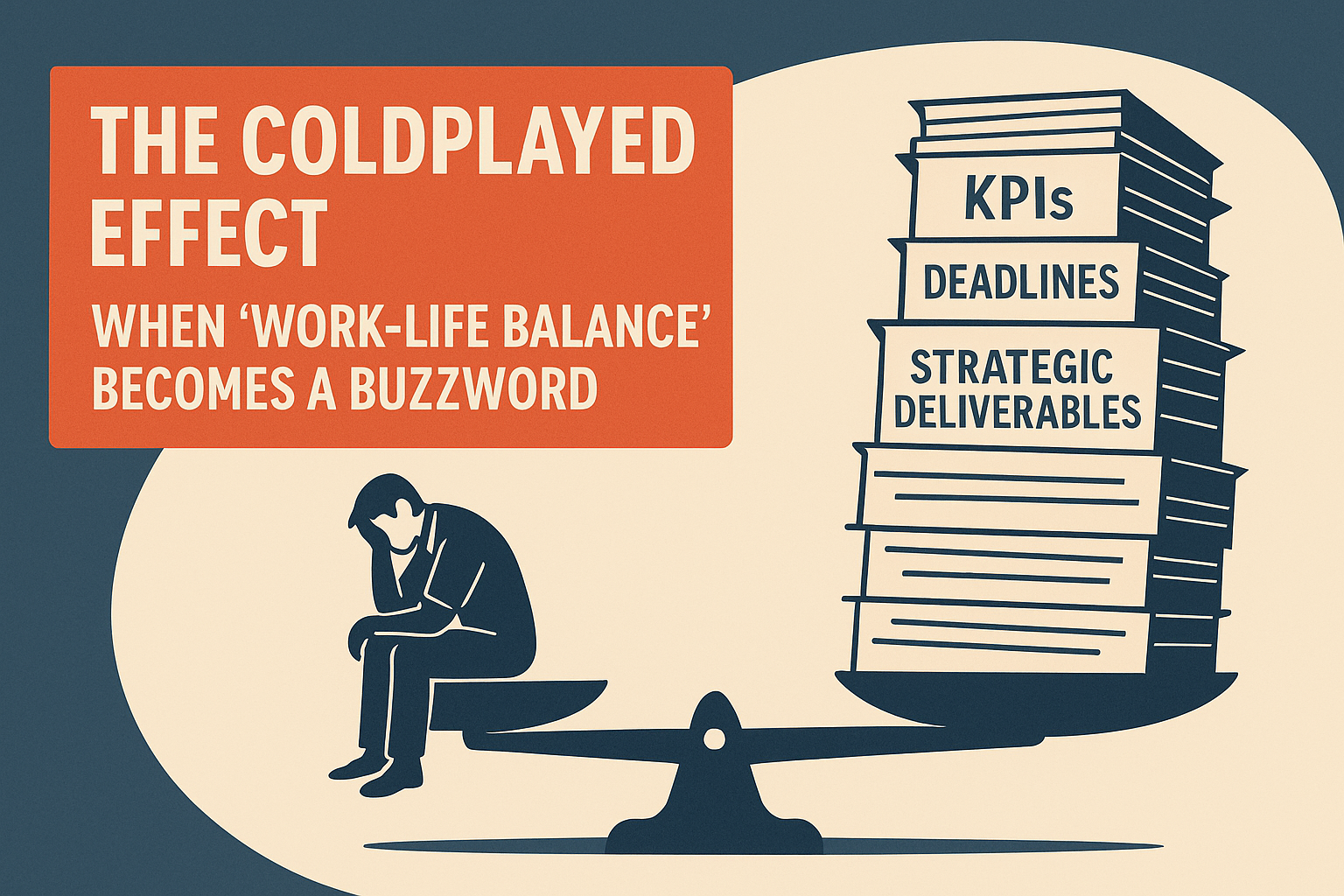
But corporations are not families. They are not lifelong covenants. And loyalty, by itself, is not a compensation plan.
The ColdPlayed Glossary: Official vs. Satirical Reality
Before we go further, let’s establish the language. At Where the Rubber Meets The Road, we use the ColdPlayed Glossary to expose the gap between what corporate words are supposed to mean and how they often function in real life.
| Official Corporate Meaning | Satirical Reality |
|---|---|
| Loyalty: A strong feeling of support or allegiance. | The reason your workload keeps expanding while your paycheck remains mysteriously stationary. |
| Commitment: Dedication to the organization’s goals. | Proof that you will accept one more “temporary” responsibility without asking what happens to your existing job. |
| We’re all family here: A statement about community and belonging. | A guilt-based invitation to work late, skip vacation, and feel selfish for noticing. |
| Opportunity: A chance to grow professionally. | Additional work with no title change, no raise, and a cheerful request to “lean in.” |
This is the Values-Performance Disconnect at work. The company says loyalty is precious. Then it treats your loyalty like an unlimited corporate credit card.
“I feel like I’m reading lines from a script I never auditioned for just to keep my health insurance. Every time HR talks about ‘our shared family,’ I check my pockets to make sure my wallet is still there.”
That quote captures the ColdPlayed Effect perfectly: the organization performs care while quietly converting your dedication into more output.

5 Ways Corporate Loyalty Becomes a Trap
1. Your reliability becomes a resource they stop valuing
At first, being dependable feels rewarding. You solve problems. You volunteer. You stay late because the project matters and your team needs help.
Then something shifts.
The extra work becomes your “normal.” Your flexibility becomes an expectation. Your willingness to rescue a broken process becomes evidence that the process is not broken after all.
Why hire another person when you are already doing the work of three?
This is where employee exploitation hides: not always in dramatic abuses, but in the slow normalization of unreasonable demands.
The loyal employee is often treated as the safest place to dump a crisis. You are less likely to refuse. You know the systems. You care about the outcome. You do not want your colleagues to suffer.
So the organization keeps testing the limits.
How much more can you carry before you finally drop the entire corporate piano?
2. Loyalty can become a pay penalty
The company knows what you made when you started. It knows the limits of your current salary band. It knows your raise history.
What it may not want to know is your current market value.
External hires often enter organizations with compensation closer to current market rates, while existing employees receive incremental increases that may not keep pace with their responsibilities. Your institutional knowledge becomes invaluable in speeches: and strangely affordable in payroll.
This creates a loyalty penalty:
- You stay because you believe tenure will be rewarded.
- Your responsibilities grow faster than your compensation.
- New hires arrive at higher salaries for comparable work.
- You are praised for being “mission-driven” instead of being paid fairly.
- You finally explore the market and discover you were underpriced for years.
What did your loyalty buy you?
A coffee mug celebrating five years of service and the privilege of training the person hired above you.
3. The psychological contract is rarely symmetrical
The formal employment contract tells you what you are paid to do. The psychological contract contains everything else you believe has been promised: fair treatment, respect, development, honesty, reasonable support, and some degree of stability.
You show up with trust.
The company shows up with an employee handbook and a restructuring plan.
Research discussed by MIT Sloan Management Review has long examined how downsizing and restructuring damage this unwritten agreement. When employees see loyal, high-performing colleagues dismissed without meaningful consideration, they learn the real lesson:
The company’s loyalty is conditional. Yours is expected to be unconditional.
That is not a relationship. That is a one-sided transaction wearing a friendship costume.
4. “We’re all family” can make leaving feel like betrayal
The family metaphor is powerful because it works.
If the company is merely an employer, leaving for a better opportunity is a business decision. But if the company is your family, leaving can feel disloyal, selfish, or even morally wrong.
That emotional confusion is not accidental. It is one of the most effective tools in corporate culture manipulation.
A real family does not typically eliminate your health coverage because quarterly results missed expectations. A real family does not tell you that your role has been “rightsized” while executives receive retention bonuses.
The organization may care about you. Your manager may care about you. Your coworkers may absolutely care about you.
But the corporation itself is structurally designed to protect the business: not guarantee your long-term wellbeing.
That distinction matters.
5. Your identity gets fused with the company
The longer you stay, the more the organization can become part of your identity.
You are not just working at the hospital; you are part of the hospital. You are not just employed by the startup; you are building the future. You are not just on the team; you are the person everyone depends on.
This can create workplace identity entanglement. The company’s success begins to feel like your success. Its criticism feels personal. Its failures become your burden to fix.
So when the culture becomes toxic, you do not simply think, This job is unhealthy.
You think, Maybe I am the problem. Maybe I am not committed enough. Maybe I need to work harder.
That is how workplace betrayal becomes self-blame.
What the Data Says About Feeling Trapped
A global study summarized by MIT Sloan Management Review surveyed more than 9,700 employees across 32 countries and found that employees fell into several categories:
- 34% Truly Loyal
- 8% Accessible
- 31% Trapped
- 27% High Risk
The important word here is trapped.
These employees wanted to leave but felt unable to do so. Maybe they needed the health insurance. Maybe they were supporting a family. Maybe their industry had contracted. Maybe years of loyalty had left them with fewer recent skills, weaker networks, or a resume that had become too closely tied to one organization.
So let’s ask the uncomfortable question:
What kind of loyalty requires you to feel you have no exit?
Healthy commitment should be voluntary. If staying feels like a cage, the behavior may look like loyalty from the outside: but internally, it is survival.
How to Escape the Loyalty Trap Without Becoming Cynical
The answer is not to become careless, cruel, or indifferent. The answer is bounded loyalty.
You can care about your work without handing over your identity. You can do excellent work without making yourself permanently available. You can support your colleagues without allowing the company to use your conscience as a staffing strategy.
1. Define the exchange clearly
Your employer pays you for your work. You provide skill, effort, honesty, and professionalism.
That exchange can be meaningful. It does not have to become a blood oath.
Ask:
- What is actually in my job description?
- What responsibilities have been added without compensation?
- Which promises were made verbally but never honored?
- What would fair reciprocity look like here?
2. Track contributions: not just praise
“Great job” is not a promotion.
Keep a record of measurable results, expanded responsibilities, successful projects, client wins, cost savings, and leadership contributions. Do not let your accomplishments disappear into the corporate fog machine.
If the company cannot explain how your value translates into pay, advancement, or development, you have information.
3. Maintain an exit option
Update your resume before you need it. Build relationships outside your company. Learn what your skills are worth. Keep your professional network alive.
An exit option is not an act of disloyalty. It is a boundary.
You are allowed to have choices.
4. Watch actions, not slogans
Read the company’s values. Then study:
- Who gets promoted?
- Who gets protected?
- Who gets blamed?
- Who receives flexibility?
- Who gets cut first?
- What happens when someone tells the truth?
The real culture is not on the wall. It is in the consequences.
For more language to help you identify these contradictions, explore the ColdPlayed Glossary and download the free 10 Signs You’re in a ColdPlayed Culture guide.
5. Reclaim your loyalty
Your deepest loyalty belongs to your health, your principles, your family, your future, and the people you love: not to a logo that can replace you with an email announcement.
That does not mean every company is evil. It means every corporation should be evaluated by what it does, not what it says.
The Loyalty Test
Here is the simplest test:
If you stopped overfunctioning tomorrow, would the company still treat you as valuable: or would it reveal that your value was based on how much pain you could quietly absorb?
That is the heart of the ColdPlayed Effect.
The corporation wants your devotion but reserves the right to change the deal. It wants your passion but calls your boundaries a lack of commitment. It wants you to think like an owner while reminding you, during every restructuring, that you are not one.
So give your best effort: but do not give everything.
Build a career, not a shrine.
And if you want the deeper framework for recognizing toxic workplace culture, performative leadership, and organizational betrayal, learn more about Dr. Eric Fishon’s upcoming book, The ColdPlayed Effect. It is for everyone who has been told to trust the values while watching leadership violate them in real time.
Have you ever stayed at a company because you believed your loyalty would eventually be rewarded? What did you receive: and what did it cost you?
Share your story with us for the upcoming book. You can also take the free ColdPlayed workplace quiz and find out whether you are a Casualty, an Observer, or an Authenticity Advocate.
Let’s stop treating corporate betrayal like a personal failure.
Where did your loyalty go; and who benefited from it?