PIVOT: The Workplace Word That Means “Smart Strategy”… or “Run.”
There are workplace words that clarify.
And then there are workplace words that sound like clarity while quietly doing something else.
“Pivot” is one of the most fascinating.
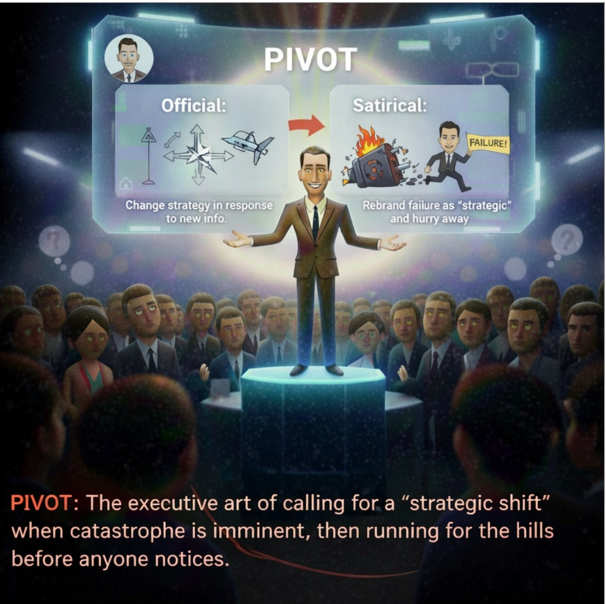
Used well, a pivot is one of the healthiest things an organization can do: it is a disciplined response to new information, a sign that leaders are listening, learning, and adapting. Used poorly—or cynically—“pivot” becomes a corporate smoke bomb: a way to rebrand a looming failure as strategic brilliance while everyone politely pretends the plan wasn’t on fire five minutes ago.
Welcome to the two meanings of pivot.
We’ll revisit resourcing in Q3.”
And just like that—
the plan didn’t fail. It evolved.
How to Tell the Difference: Real Pivot vs. Reputational Fire Drill
If you want to know whether the pivot is real or performative, listen for what comes next.
A pivot is real when leadership can answer these questions plainly:
- What new evidence changed our mind?
- What are we stopping—explicitly?
- What are we keeping, and why?
- What does success look like now (30/60/90 days)?
- Who owns this, and what resources are assigned?
A pivot is performative when the new direction is described only in vibes:
- “We’re refocusing.”
- “We’re realigning.”
- “We’re simplifying.”
- “We’re accelerating.”
- “We’re being agile.”
If a pivot cannot be described without motivational language, it is not a pivot.
It is rebranding.
Why “Pivot” Became Executive Perfume
Because pivoting offers something rare in corporate environments:
movement without confession.
It implies:
- “We learned.” (without admitting “we were wrong.”)
- “We’re agile.” (without discussing “we ignored warnings.”)
- “We’re future-ready.” (without explaining “we didn’t do the basics.”)
In healthy cultures, pivots protect the company from stubbornness.
In unhealthy cultures, pivots protect leaders from accountability.
The Five Most Common Pivot Species (You’ve Seen These)
1) The KPI Escape Hatch
Metrics look bad → redefine the metrics
2) The Reorg Pivot
Same problem → new org chart → same problem returns in 90 days wearing a new badge.
3) The Buzzword Pivot
Product stays the same → story changes → the deck gets prettier.
4) The Blame-Shift Pivot
Strategy “evolves” → ownership dissolves → frontline absorbs impact.
5) The Layoff Pivot
Budget crisis → “operational excellence initiative” → morale becomes a rounding error.
A Professional Response When Someone Announces “We’re Pivoting”
You do not have to be cynical. You can be calm, constructive, and still demand clarity.
Here are questions that are both professional and revealing:
- “What new data triggered this shift?”
- “Which initiatives are we pausing or ending as a result?”
- “What does success look like in 30/60/90 days?”
- “What risks are we accepting by moving this direction?”
- “What’s the plan to support frontline teams through the transition?”
These questions don’t attack anyone.
They simply require leadership to translate the pivot from branding into execution.
And that is where fake pivots struggle.
The Bottom Line
A pivot can be a sign of organizational maturity—or a sign that someone is trying to outrun consequences.
If it’s a real pivot, it will come with:
evidence, trade-offs, owners, timelines, and measures.
If it’s not, it will come with:
a slide deck, a town hall, and a new slogan.
If you’ve lived through a “pivot,” you already know:
Not all pivots change strategy. Some just change who gets blamed.
— Dr. Disruptor | ColdPlayedEffect.com